One of the most popular Facebook posts in Iraq’s Shiite heartland is a Photoshopped image of President of Russia dressed in the robe of a southern tribal sheikh.
It was the American-led invasion in 2003 that toppled Saddam Hussein and empowered ’s long-repressed Shiite majority. The United States also took the lead more than a year ago to assemble a coalition to conduct airstrikes in Syria and Iraq against the Sunni militants of the Islamic State.
But with the struggle against the Islamic State largely stalemated, it is the naked display of Russian military power in neighboring Syria, as well as the leadership of “Sheikh Putin,” that is being applauded by residents of this Shiite power center. Russian planes continued to hit targets in Syria on Sunday, the Russian Defense Ministry said.
“What the people in the street care about is how to get Daesh out of Iraq,” Ibrahim Bahr al-Ulum, a member of Iraq’s Parliament, said, using an Arabic name for the Islamic State, also known as ISIS or ISIL. “Now they feel is more serious than the United States.”
As if to underscore that point, one widely viewed YouTube video shows Mr. Putin striding purposefully to the sounds of a patriotic Iraqi song, which hails him as a leader with the vision and determination to bring stability to Iraq.
“We don’t have to say his name; he knows himself well,” the singer belts out in the video, which ends with a clip of Mr. Putin conferring with President Hassan Rouhani of Iran.
Much of the popular fascination here with “Sheikh Putin” stems from the projection of sectarian politics onto the international stage.
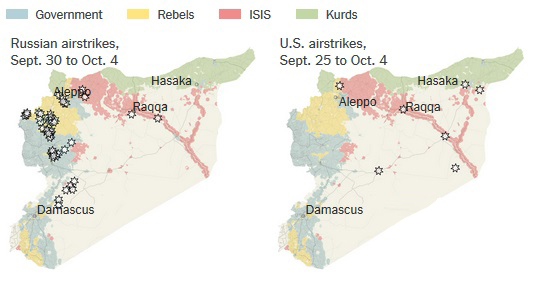
Russian and U.S. Airstrikes Show Differing Goals
Further fueling Shiites’ concerns is the perception that the American-backed campaign against the Islamic State in Iraq is moving too slowly and that the United States is no longer interested in being the dominant military power in the Middle East.
At a seminar of journalists and civic leaders here last week, Faris Hammam, the leader of the local writers’ union, asked how many attendees were glad the Russian military was carrying out airstrikes in Syria. Most shot up their hands.
“The Russian intervention is welcomed, not because they like intervention but because of the American failure,” Mr. Hammam said.
Few Iraqis are aware of the United States’ assertion that most of the Russian strikes in Syria have been directed at opponents of Mr. Assad, not at the Islamic State. Those details have been overshadowed by the dramatic images of Russian planes blasting their targets below.
“In the Middle East, what often counts is strength — or at least the illusion of it,” said Hayder al-Khoei, an associate fellow at Chatham House, a London-based international affairs research group.
Many Iraqis are uneager for the United States to send large numbers of ground troops back to their country, and the effort to rebuild the Iraqi Army has been hampered by Iraq’s failure to recruit more volunteers. But an array of factors have shaped the perception of Russia’s role.
While sectarian tensions are clearly one element, many Iraqis also harbor resentment at the extravagant and unfulfilled expectations that the American occupation should have rebuilt Iraq. Steeped in conspiracy theories, some say that the Islamic State’s persistence on the battlefield can only be a grand design of Washington.
“The Americans have the technology to spot water on Mars,” said Ahmed Naji, a professor at Kufa University. “So why can’t they defeat ?”
For Iraqis who recall the American military juggernaut that toppled Mr. Hussein, the progress produced by the airstrikes and the effort by the United States to advise and train the Iraqi Army seem inexplicably slow.
Wary of being caught up in the fighting, the Obama administration has limited the mission of the approximately 3,500 American advisers and other military personnel in the country. The advisers, for example, do not go on the battlefield to call airstrikes for Iraqi troops — a restriction a former United States commander in Iraq, David H. Petraeus, recently told Congress should be eased.
Unhappy with the Islamic State’s ability to control much of northern and western Iraq, some Iraqis would like the United States to strengthen its military effort by increasing the number of advisers, broadening their role and cracking down on the militants’ supply lines from Turkey.
“We have to put pressure on the United States to change their attitude and make more actions to help the Iraqi people,” Mr. Bahr al-Ulum, the Iraqi Parliament member, said.
Mohammed Hussain Hakim, a prominent Shiite cleric, said that Moscow’s new cachet said more about Iraqis’ frustration with the pace of the joint American, allied and Iraqi campaign against the Islamic State than about support for Mr. Putin. “The war against ISIS was slow,” Mr. Hakim said in an interview. “The Iraqi street wants effective, practical engagement against ISIS,” he added. “It is not about Russian military intervention per se.”
Still, the groundswell of Shiite support for Russia’s actions already appears to be influencing Iraq’s Shiite-dominated government. The Russian transport planes that ferried weapons and equipment to the Kremlin’s new base in Latakia, Syria, passed through Iraqi airspace without complaint from the Iraqi authorities. And the Iraqi military announced last month that it had joined a working group to share intelligence with the Russian, Iranian and Syrian governments.
But there appear to be limits to Russian-Iraqi military cooperation. While Hakim al-Zamili, the leader of Parliament’s defense and security committee, has gone so far as to suggest that the Russian-led coalition might one day supplant the American-led one in Iraq, there is nothing to suggest the government has such a plan.
Still, with his eye on his public and possibly Russia’s Iranian ally, Prime Minister Haider al-Abadi of Iraq has been careful not to slam the door on cooperation with Moscow.
“Inside Iraq, there are very dangerous guys, so I think to have the Russians on board will help me,” Mr. Abadi told PBS NewsHour this month.
The Russian Defense Ministry reported Sunday that the country’s jets flew 64 sorties over Syria in the past day, indicating that the pace of the bombing runs was increasing. In the first week, the military announced around 30 sorties per day from the Latakia base. The military reported destroying what it called a terrorist safe house, five off-road vehicles, mortar positions, three terrorist training camps, seven ammunition depots and other targets.
/149